200 Cute Child Vegetables Color Pages: A Creative Asset
Transforming Marketing with Wholesome Visuals
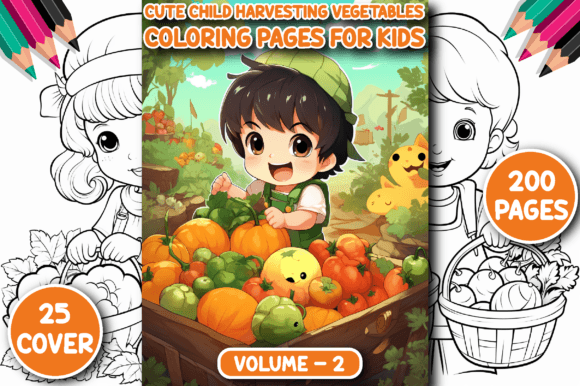
As content creators and entrepreneurs, we often search for that specific visual element that bridges the gap between professional branding and approachable warmth. The 200 Cute Child Vegetables Color Pages collection offers exactly that intersection. This bundle isn't just a stack of coloring sheets; it is a comprehensive design asset tailored for the education, wellness, and family lifestyle sectors. With 200 unique illustrations and 20 premium book covers, this package provides a robust library of imagery that speaks to health, agriculture, and the innocence of childhood. Whether you are building a brand identity for an organic farm, designing educational worksheets, or creating a digital product for a parenting blog, these assets provide a distinct visual language that is both engaging and versatile.
The aesthetic of the 200 Cute Child Vegetables Color Pages is characterized by "wholesome harvest scenes." We are looking at heartwarming illustrations where children are actively engaged with nature—picking tomatoes, holding vibrant carrots, or standing amidst lush greenery. The style avoids the harsh lines of modern minimalism, opting instead for soft, inviting contours that are perfect for coloring. This visual personality is crucial for brands aiming to project trustworthiness and a connection to nature. Unlike generic stock photography, these vector-style illustrations allow for a level of customization that is rare in standard design assets. You can resize them for everything from small social media icons to large print banners without losing quality, making them a practical staple in any creative professional’s toolkit.
Strategic Applications for Entrepreneurs and Designers
Understanding where to deploy the 200 Cute Child Vegetables Color Pages is key to maximizing their value. For graphic designers and brand strategists, these illustrations serve as an excellent foundation for "packaging design" and "logo design," particularly for brands in the children’s food, educational toy, or gardening sectors. Imagine a farm-to-table restaurant using a stylized version of a harvesting child as part of their menu design or a children’s book publisher using these pages as interior art. The collection includes 20 premium book covers, which is a significant asset for self-publishers. These covers are pre-designed to handle the "visual hierarchy" needed for a physical or digital product, allowing you to focus on typography and title placement rather than sourcing expensive illustration commissions.
Furthermore, in the realm of "web design" and "social media graphics," the versatility of the 200 Cute Child Vegetables Color Pages shines. Content creators can use individual illustrations as featured images for blog posts about healthy eating or family activities. The "interactive learning" aspect mentioned in the product description suggests these pages are not just for viewing but for doing. Entrepreneurs can monetize this by offering these as free downloads to build email lists or as part of a paid subscription service. For "editorial design," these images break up text-heavy layouts, improving "readability" and keeping the reader engaged. The ability to "download & customize your own style" means you can adjust colors to match a specific "brand identity," ensuring consistency across all your marketing channels.
Practical Guidance for Integration and Licensing
When integrating the 200 Cute Child Vegetables Color Pages into your workflow, consider the "font pairing" and overall typography strategy. Because the illustrations have a playful, hand-drawn quality, they pair best with "handwritten fonts," "script fonts," or friendly "sans serif fonts." Avoid overly rigid "serif fonts" or cold "modern typography" that might clash with the warm, agricultural theme. For example, if you are creating a "brand identity" for a children's gardening club, pairing a rounded sans-serif header with a playful script sub-header creates a balanced "visual hierarchy" that complements the illustrations without competing for attention.
From a practical standpoint, always review the commercial licensing associated with these "design assets." While the prompt notes the ability to customize, ensuring you have the rights for your specific usage—be it "commercial font" projects, merchandise, or digital resale—is essential for professional integrity. Treat these pages as you would a "premium font": test them in your specific environment before finalizing a design. Create mockups to see how the illustrations look in low light (for digital screens) or on textured paper (for print). The "simple and" engaging nature of the art means they can be scaled down effectively, but always test "readability" and clarity at the smallest intended size. By treating the 200 Cute Child Vegetables Color Pages as a serious component of your design system rather than just clipart, you elevate the professionalism of your final output, whether it is a printed book, a website, or a marketing campaign.